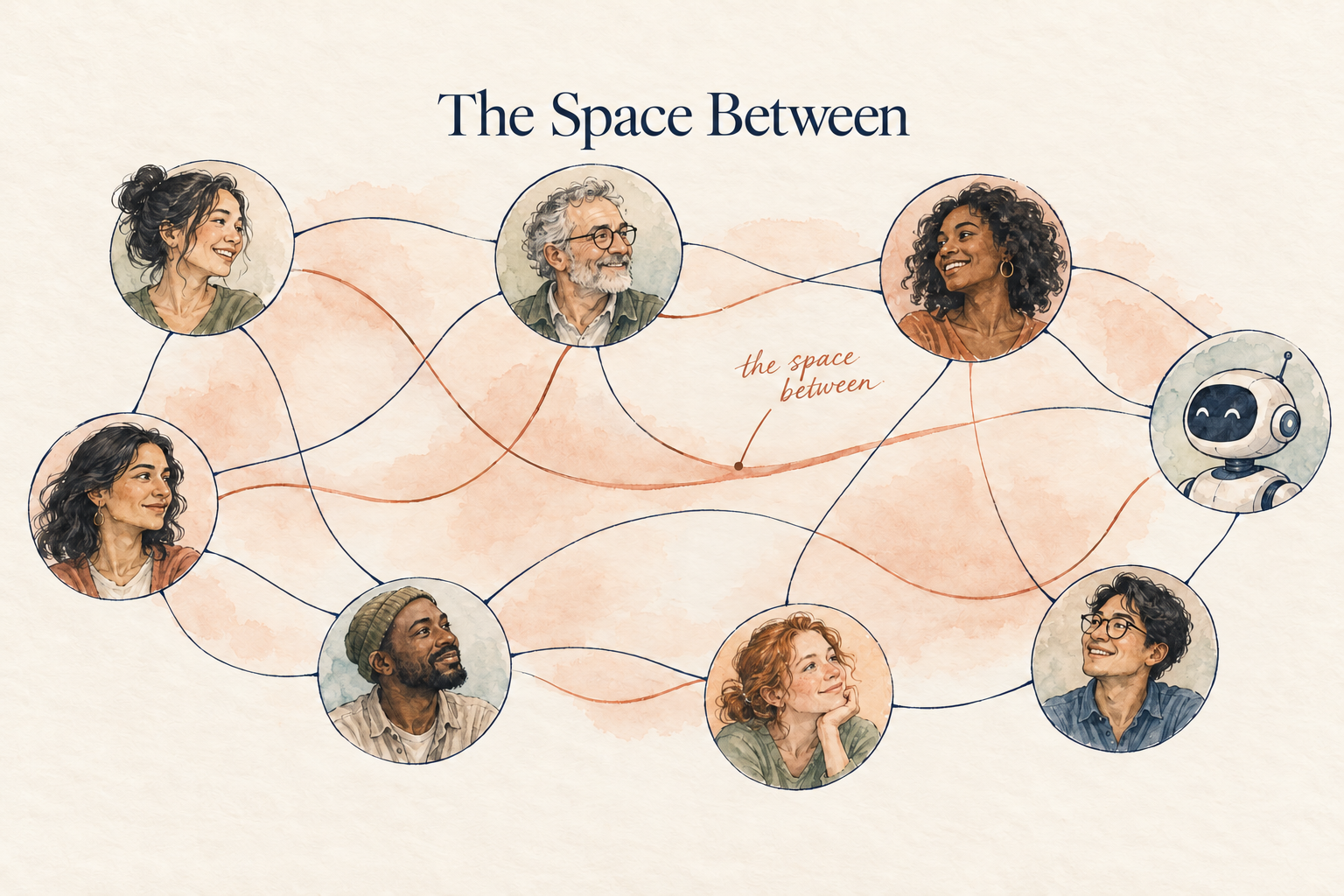
The Space Between
We keep upgrading the actors. The relationships still run on an older version.
The analysis is ready in minutes. Turning it into a decision still requires three meetings, two approvals, and someone who knows whom to call. A contribution has become faster. The organization’s ability to use it may be unchanged.
Much of organizational effectiveness depends on the space between its actors: the relationships through which knowledge travels, perspectives meet, and contributions become shared action. Someone understands the customer, someone knows the technology, and someone remembers why the process exists. Connecting those perspectives can reveal possibilities none would have recognized alone. An organization’s intelligence depends partly on how well those connections work.
Put people in the right relationships and knowledge begins to travel.
These relationships take shape through expectations, communication, trust, and authority. Roles and incentives influence them; everyday encounters reinforce or revise them. People learn whether questions are welcome, whether sharing knowledge helps, and whether a disagreement can improve a decision. A team asked to collaborate while everyone is rewarded solely for individual results receives competing instructions. The workshop may have excellent catering. The incentive still gets the last word.
This is why transformation needs attention to relationships alongside structures and capabilities. A new reporting line can leave familiar dependencies intact. A new strategy can arrive while access, approval, and recognition continue to follow the old arrangement. Successful change requires conditions in which people can contribute differently together – and enough shared understanding to make that possible.
AI is another actor. Its role needs relationships, too.
Introducing AI changes the combination of contributions available to an organization. It also requires clarity about how those contributions relate: what people can expect from the system, what authority it has, how its outputs are challenged, and who remains responsible for decisions. Its role as an actor does not make it equivalent to a person.
The relationships between people change as well. When AI prepares an analysis, colleagues may gain time for interpretation – or face a growing queue of material to review. When it takes over an activity, it may also remove an occasion for learning or exchanging context. The organizational opportunity lies in deliberately shaping this new interplay so that greater capability supports better judgment, cooperation, and action.
Three Horizons gives the space between a direction.
McKinsey’s discussion of enablement, automation, and reinvention brings organizational choices around AI into focus. Three Horizons can also serve as a framework for designing the relationships those choices require: considering the desired future, present conditions, and emerging alternatives together.
Horizon 3 establishes what the interplay should make possible. Knowledge flowing across boundaries, decisions informed by relevant perspectives, and room for learning give us a more useful ambition than “more AI.” Horizon 1 brings that ambition into contact with today’s relationships: those that enable contribution, those that obstruct it, and those whose value might be lost through indiscriminate automation. Horizon 2 provides room to test different arrangements and discover whether they develop the desired future or simply accelerate existing limitations.

These horizons remain connected. Experiments can reveal something worth preserving in the present or prompt a better understanding of the future. Relationships need enough clarity to support action and enough openness to develop through experience.
How we connect contributions shapes what the organization makes possible—and for whom.
That gives transformation a wider purpose. Increased capacity can support greater output, but also learning, agency, sustainable workloads, and meaningful contribution. The choices affect employees, customers, suppliers, and communities. Designing the space between therefore includes deciding which outcomes matter and whose experience informs those decisions.
Human flourishing offers a direction for that ambition – and a question for the next conversation: How could we use AI to make human flourishing a lasting part of organizational decisions and impact, within the company and beyond its boundaries?
Source and starting point: McKinsey, “From adoption to impact: Three horizons of AI transformation”
Leave a Reply